


Smart cities, smart homes: IoT solutions for green living
With over 27 billion (2017) IoT devices recorded worldwide, the IoT (internet of things) technology’s growing share in the digital economy raises new questions such as “how to define IoT” and “how to measure it”.
What is IoT?
According to the OECD definition, IoT includes “all devices and objects whose state can be altered via the Internet, with or without the active involvement of individuals.” Traditional connectivity devices such as laptops, routers, servers, tablets and smartphones are placed in the IoT category as well.
In contrast, McKinsey defines IoT as “sensors and actuators connected by networks to computing systems”, excluding the sensors which require intentional human input such as a touchscreen, standard keyboard and mouse.
Meanwhile, IBM refers to IoT as the growing range of connected devices that send data across the Internet.
The number of IoT devices is forecast to increase up to 45 billion by 2021, which opens a debate on communication infrastructure such as 5G, as various IoT applications would require different network requirements. For example, whereas automated vehicles are sensitive to latency issues and network speed, agricultural applications using machine-to-machine sensors are not time-sensitive.
In Japan, the IoT strategy focuses on four major areas: “connected vehicles”, “digital healthcare”, “smart manufacturing”, and “smart city”. The growth in IoT applications is expected to be the highest in manufacturing sector (34.1 percent), followed by healthcare (22.1 percent), space and aviation (20.5 percent), and auto sector (17.7 percent) between 2018 and 2021.
How to build a “smart home” with IoT
Internet services company LASTONEMILE Corp. announced the launch of a “smart home” service as part of its Marutto connectivity platform. First of its kind in Japan, the subscription service for “internet of things in the home” is available in six prefectures of Osaka, Kyoto, Hyogo, Nara, Shiga and Wakayama, starting from October 1 2019.
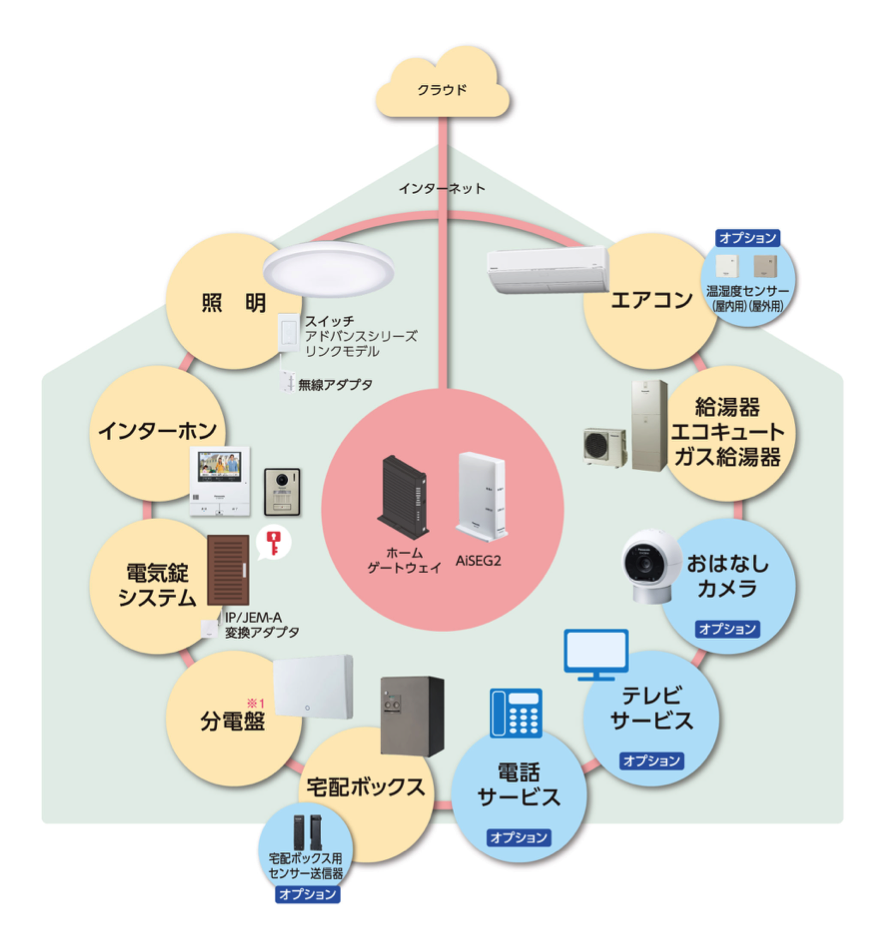
To build a “smart home”, the service combines fibre-optic internet connection of up to 1Gbps speed by NTT West Corp. and IoT device AiSEG2/HEMS (Home Energy Management System) by Panasonic Corp.
By setting up the IoT device at home and downloading the app, users can manage various household tasks anywhere and anytime. AiSEG2/HEMS visualizes collected data on the device screen, controls energy consumption, prepares solar units for recharging upon checking the weather, and manages connected household appliances among other functions.
AiSEG2/HEMS connected to a smart speaker understands human voice commands and sends notifications to a smartphone when kids return from school or if the front door is unlocked. The connected cameras help improve security and look after the elderly.
Users can rely on the company’s customer service in regard to technical issues or general queries. A monthly subscription fee is 5,980 yen ($55), but there are also initial expenses such as cost of the IoT device and its installation.
While the cost issue remains to be addressed, the system is viewed as a suitable solution to the needs of the aging society and environment protection, and the government aims to complete the installation of AiSEG2/HEMS in every household in Japan by 2030.